TacFiLM overview comparing VLA baselines

Tactile Modality Fusion for Vision-Language-Action Models

Preprint 2026

We introduce TacFiLM, a lightweight method to incorporate tactile feedback into VLA models. By conditioning visual features with tactile representations via FiLM, robots can feel what they cannot see: contact forces, friction, and compliance. This leads to better performance on contact-rich manipulation tasks.

2 min · Charlotte Morissette, Amin Abyaneh, Wei-Di Chang, Anas Houssaini, David Meger, Hsiu-Chin Lin, Jonathan Tremblay, Gregory Dudek
Concept: contraction in diffusion sampling

Contractive Diffusion Policies

ICLR 2026

CDPs add a simple contraction regularizer to diffusion policies, pulling nearby sampling trajectories together to suppress solver and score-matching errors. This yields more robust action generation in offline RL and imitation learning, especially in low-data regimes.

2 min · Amin Abyaneh, Charlotte Morissette, Mohamad Danesh, Anas Houssaini, David Meger, Gregory Dudek, Hsiu-Chin Lin
VOCALoco design overview

VOCALoco: Viability-Optimized Cost-Aware Adaptive Locomotion

RA-L 2026

VOCALoco predicts the viability and cost of transport for several pretrained locomotion skills from local heightmaps, then executes the safest, most efficient one. It improves robustness on stairs and transfers zero-shot to real hardware.

2 min · Stanley Wu, Mohamad H. Danesh, Simon Li, Hanna Yurchyk, Amin Abyaneh, Anas El Houssaini, David Meger, Hsiu-Chin Lin
SCDS design overview

Contractive Dynamical Imitation Policies for Efficient Out-of-Sample Recovery

ICLR 2025

Imitation learning policies often fail when robots drift out-of-sample. We propose SCDS, a framework that models policies as contractive dynamical systems, ensuring all rollouts converge regardless of perturbations. The architecture guarantees contractivity by construction, enabling unconstrained optimization. We also provide formal bounds on worst-case and expected loss, and demonstrate strong out-of-sample recovery on manipulation and navigation tasks.

3 min · Amin Abyaneh*, Mahrokh Boroujeni*, Hsiu-Chin Lin, Giancarlo Ferrari-Trecate
SNDS method overview

Globally Stable Neural Imitation Policies

ICRA 2024

We propose SNDS, a neural imitation learning approach with formal global stability guarantees. By jointly training a neural policy and a Lyapunov candidate, the method ensures safe, predictable behavior beyond the training distribution, overcoming instability and computational issues of prior methods.

2 min · Amin Abyaneh, Mariana Sosa Guzmán, Hsiu-Chin Lin
PLYDS design overview

Learning Lyapunov-Stable Polynomial Dynamical Systems through Imitation

CoRL 2023

Links Paper Project page Slides Missing my first conference Unfortunately, I couldn’t attend my first conference paper presentation at CoRL'23 due to US visa processing delays. I applied for a visa well in advance, but faced significant backlog issues that persisted beyond the conference date. As of then (several months after submission), I was still awaiting visa approval, which had been pending since October 2023. The approach Most imitation learning methods learn to copy expert trajectories, but have no guarantees about what happens when the robot drifts off the demonstrated path. That’s a real problem in practice. Earlier work used stable dynamical systems to at least guarantee convergence back to the goal, but those methods tend to struggle with accuracy on complex, highly nonlinear trajectories, or come with significant computational cost. ...
2 min · Amin Abyaneh, Hsiu-Chin Lin
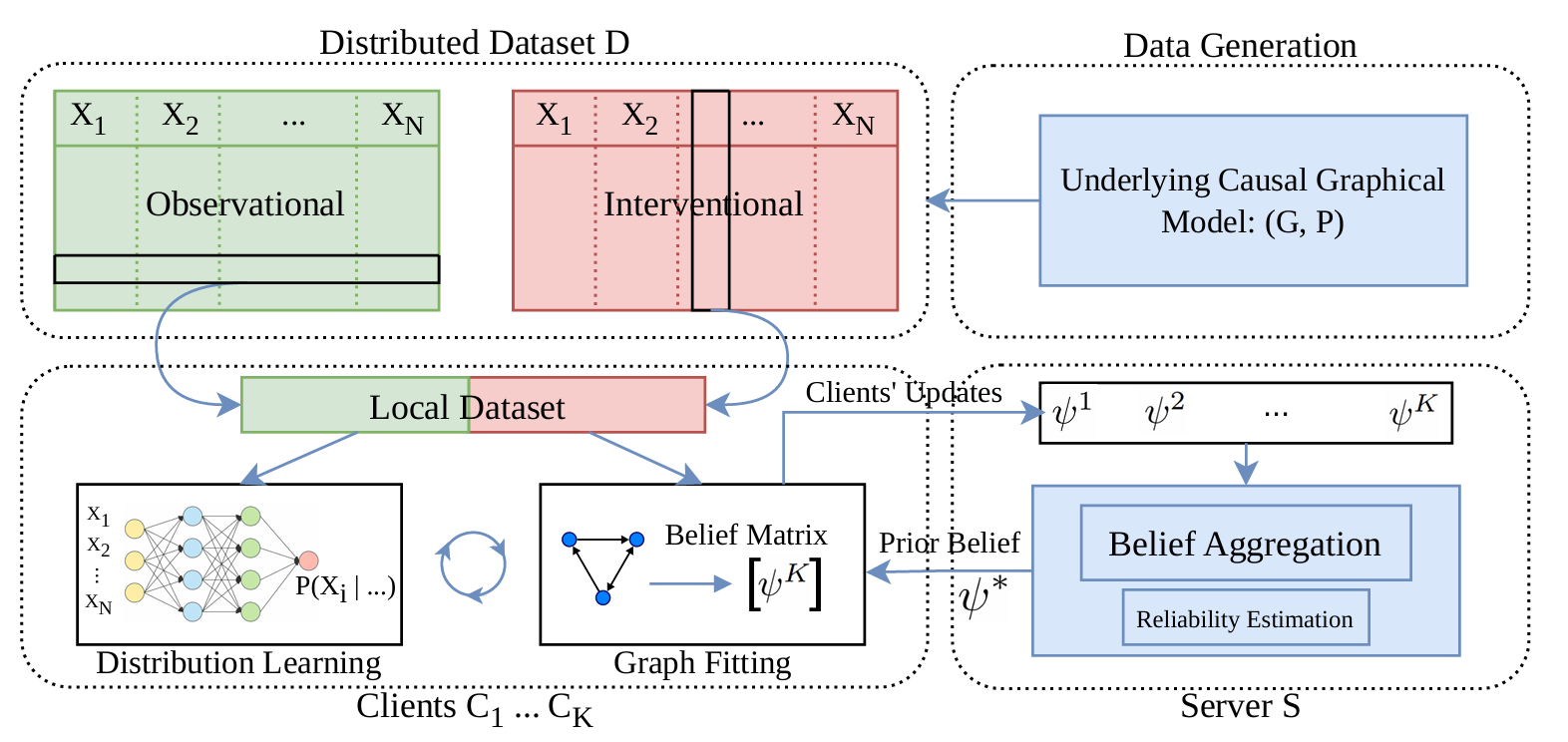
FedCDI framework design

Federated Causal Discovery From Interventions

Preprint 2022

We propose FedCDI, a framework for causal discovery in federated settings where data cannot leave local sites. Rather than sharing raw samples, clients exchange belief updates over causal graphs, enabling privacy-preserving inference from both shared and heterogeneous interventional data.

3 min · Amin Abyaneh, Nino Scherrer, Patrick Schwab, Stefan Bauer, Bernhard Schölkopf, Arash Mehrjou